
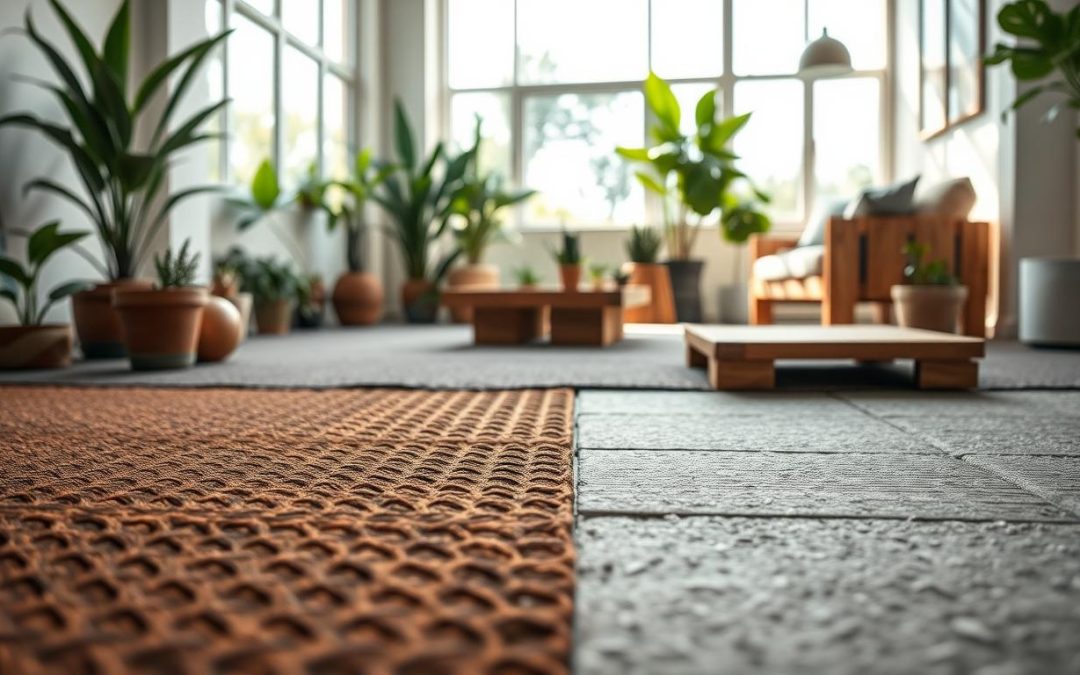
Recycled rubber flooring transforms end-of-life tyres into one of the most resilient, sustainable surface materials available today. By choosing recycled rubber mats and tiles, businesses reduce landfill waste, lower their environmental footprint and gain a product engineered for performance in the most demanding environments.
What is recycled rubber flooring?
Recycled rubber flooring is manufactured from cryogenically or mechanically ground rubber granulate sourced primarily from used vehicle tyres. The granulate is cleaned, sized and bonded with polyurethane or similar binders, then moulded or pressed into mats, tiles, rolls and pour-in-place surfaces. The result is a dense, elastic material that retains the shock-absorbing and weather-resistant properties of the original rubber.
Environmental benefits
Every tonne of recycled rubber flooring diverts roughly 100 used tyres from landfill or incineration. The manufacturing process consumes a fraction of the energy required for virgin rubber and produces far fewer greenhouse gas emissions. Many recycled rubber products are themselves recyclable at end of life, closing the loop in a circular materials economy.
Where recycled rubber flooring performs best
- Commercial gyms and fitness studios — absorbs dropped weight impact, dampens noise and provides reliable grip.
- Industrial workshops — resists oils, chemicals and abrasion while reducing operator fatigue.
- Playgrounds and outdoor sports surfaces — weatherproof, UV-resistant and impact-attenuating.
- Equestrian facilities — comfortable for horses, easy to clean and exceptionally durable.
- Multi-family housing — controls impact noise between floors when used as an underlay.
Performance characteristics
Recycled rubber mats offer impressive technical performance. Typical specifications include compressive strength of 5–10 N/mm², density of 700–1100 kg/m³, slip resistance class R10–R11 and noise reduction values of 18–28 dB depending on thickness. These figures rival many virgin-rubber and synthetic products at a significantly lower environmental cost.
Choosing the right product
When specifying recycled rubber flooring, match thickness to expected impact loads, confirm slip and fire ratings against your local building codes, and ask for binder safety certifications (look for low-VOC or REACH-compliant formulations). Quality manufacturers provide third-party test reports for every product line.
Installation considerations
Recycled rubber tiles and mats can be loose-laid, double-sided taped or fully bonded with rubber-compatible adhesives depending on the application. Outdoor and wet-area installations benefit from full bonding to prevent water ingress and edge curling. Always allow the material to acclimatise to the installation environment for at least 24 hours before laying.
The sustainability case
For organisations pursuing ESG or green building certifications such as LEED or BREEAM, recycled rubber flooring contributes points for recycled content, low-emitting materials and regional sourcing (when locally manufactured). It is one of the simplest specification swaps that delivers measurable environmental impact alongside excellent performance.
Conclusion
Recycled rubber flooring proves that sustainable choices need not compromise on performance. Durable, safe, low-maintenance and made from waste that would otherwise pollute, it is the rational specification for any project where resilience and responsibility matter equally.